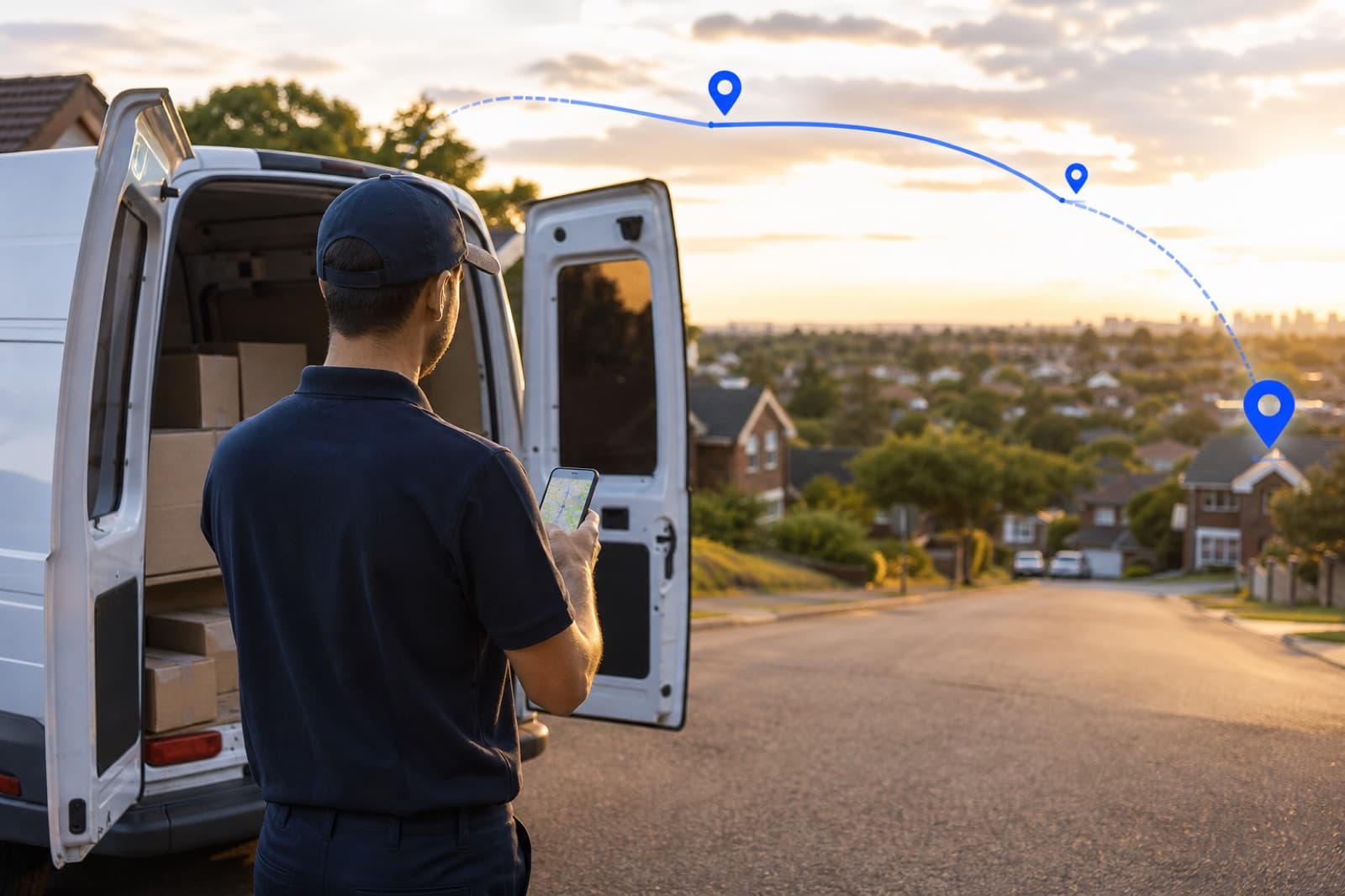
If you drive for a living — packages, food, flowers, or anything else — your route is your income. Every wasted mile is wasted time, and wasted time is wasted money. Efficient route planning is one of the highest-leverage skills a delivery driver can develop.
This guide covers practical tips that work whether you're an independent courier, a gig driver, or running your own small delivery business.
Start with a plan, not a feeling
The biggest mistake delivery drivers make is starting their route by feel — taking the first job and then picking the next one that "seems close." This leads to constant backtracking and a route that looks like a bowl of spaghetti on a map.
Before your first delivery, load all your stops for the shift into a route planner and run the optimizer. Then work the list top to bottom.
Group stops by zone, then optimize within zones
For large delivery areas (50+ stops), divide your delivery area into geographic zones first. Work one zone completely before moving to the next. Within each zone, use route optimization to sequence the stops efficiently.
This "zone first, optimize within" approach is how professional couriers and logistics companies structure their operations.
Use the 25-stop limit strategically
Free Route Planner handles up to 25 stops per route. For longer shifts, plan in segments:
- Segment 1: First 20–25 stops (morning block)
- Segment 2: Next set of stops (afternoon block)
Plan your segments to end near where your next segment begins, so you don't waste time driving between blocks.
Account for time at each stop
A route that looks efficient on a map can fall apart in practice if you underestimate dwell time — the minutes spent parking, walking, waiting for a signature, or trying to find building entrances.
Realistic estimates:
- Residential deliveries: 2–4 minutes per stop
- Business deliveries (ground floor): 3–5 minutes
- High-rise buildings: 8–15 minutes per stop (elevator, reception, etc.)
- Failed deliveries (no one home): 2 minutes + possible re-attempt later
If your route shows 4 hours of driving for 30 stops, add 90–120 minutes for stop time. You're looking at a 5.5–6 hour shift minimum.
Watch out for time-sensitive stops
Some deliveries have time windows — restaurants that need supplies before the lunch rush, offices that close at 5 PM, customers who specified a delivery window. These need to be sequenced before the window closes, even if it's not the "optimal" order for driving efficiency.
Identify your time-constrained stops first and mentally lock them into the sequence. Let the optimizer handle the rest.
Plan for traffic, not just distance
Morning rush hour (7–9 AM) and evening rush (4–7 PM) can double drive times on certain roads. A route that takes 30 minutes at noon can take 60 minutes at 5 PM.
If your shift spans rush hour, try to:
- Be on highway segments before rush hour starts
- Schedule suburban/residential stops during peak hours (they're less affected)
- Plan your furthest stops during off-peak times
Re-optimize when plans change
Deliveries fail. Customers aren't home. New orders come in. Real shifts rarely go exactly as planned.
When your route changes significantly — a failed delivery that needs to be rescheduled, a new priority pickup added mid-shift — re-enter your remaining stops and re-optimize. A 5-minute replanning session can save 30 minutes of backtracking.
Keep your vehicle loaded efficiently
For larger delivery operations, load your vehicle in reverse delivery order — the last stop goes in first, the first stop goes on top or is most accessible. This sounds obvious but is frequently overlooked, leading to time wasted digging through cargo at every stop.
Track your metrics
If you do deliveries regularly, track:
- Stops per hour
- Miles per stop
- Fuel cost per delivery
- On-time delivery rate
Improving your route planning directly improves all of these. Even shaving 10 minutes off a 6-hour shift across 20 workdays is over 3 hours a month — real money when you're paid per delivery.
Tools for delivery drivers
- Free Route Planner: Up to 25 stops, free to plan, optional account to save. Best for individual drivers and small fleets.
- Google Maps: Works for basic navigation, but the 10-stop limit and lack of optimization make it less suitable for serious delivery routes.
- Routific / OptimoRoute: Enterprise tools for fleets with 50+ stops or multiple drivers. Paid but powerful.
For most independent delivery drivers and small courier businesses, Free Route Planner covers the day-to-day needs at no cost.
Summary
Efficient delivery routing comes down to a few core habits:
- Plan your full route before you start, not as you go
- Group stops geographically, then optimize the order
- Account for realistic stop times, not just driving time
- Adjust for time-sensitive deliveries
- Re-optimize when things change
Open the planner and build your next delivery route — it takes less than 2 minutes.